Moral elevation
The destination is placed above ordinary political choice. It is presented as justice, survival, or goodness itself.
Now on Amazon · Dr. Mark Dyrholm DC BComm
One accurate view can still produce an incomplete diagnosis.
Utopian Supremacy helps you recognize when worthy goals begin protecting bad decisions. Ask better questions, examine your own assumptions, and read it with someone you often disagree with.
The question behind the book
Wanting a better world is not the problem.
The danger begins when a promised future becomes too important to question. Evidence is dismissed, disagreement becomes disloyalty, and the people carrying the costs lose their voice.
Utopian Supremacy occurs when confidence in an imagined outcome is used to place the plan above the people, the theory above the evidence, and the planners above correction.
The missing X-ray
The image was real.
The interpretation needed testing.

An X-ray taken from the front can show what looks like a moth-eaten area in a vertebra, raising concern about cancer. But bowel gas overlapping the spine can create the appearance of a hole in the bone.
One view is not diagnostic in this case.
A second view, taken at ninety degrees, can help distinguish an apparent defect from actual bone damage.
Our disagreements can work the same way: each person may see something real, yet mistake that view for the whole diagnosis.
Get the book. See another perspective.Recognize the pattern
Apply the test to movements you oppose and to institutions, political tribes, and solutions you support.
The destination is placed above ordinary political choice. It is presented as justice, survival, or goodness itself.
Real tradeoffs are denied. Freedom and safety, equality and variety, or compassion and responsibility are treated as if only one side has moral standing.
Those directing the plan gain status and authority while others surrender choices, resources, relationships, or opportunities.
Bad results do not count against the theory. Failure is blamed on enemies, misinformation, incomplete implementation, or insufficient power.
People cannot refuse, leave, build alternatives, or recover what was taken. A failed compulsory experiment can cost a generation.
Most people recognize dangerous certainty in someone else. The harder task is to recognize it in ourselves.
What you will take into your next conversation
Who pays? Who decides whether the plan is working? What happens to the person who says no? What evidence would make the leaders change course?
Understand how hope, belonging, and moral purpose can draw decent people into systems that harm those they intend to help.
Look for the knowledge and consequences that a single perspective can miss. Ask what another view would reveal.
Preserve criticism and choice. Test ideas, judge their results, and make room to correct mistakes.
Your next book-club read
Read it with someone you often disagree with.
For conservatives and liberals who still believe a good conversation can get somewhere.
Do you miss the better conversations of the 1990s? The ones where people could sit down, disagree, and work toward a solution, even an imperfect one?
For those who feel that the years since 9/11 have drawn us deeper into separate camps, this book offers a shared starting point.
Bring together people willing to question their own side. Identify where your diagnoses differ, what evidence is missing, and which solutions deserve a closer look.
Buy a copy and invite someone with a different outlook to read it too. You do not have to reach the same conclusion to understand each other better.
Apply the same questions to the book’s argument. It should be open to challenge, too.
Read before you buy
From the introduction to the first edition.
Continue reading: get the book →Utopian Supremacy rarely begins with an obviously dangerous idea. It begins with something real: a wound, an injustice, a danger, or a problem that decent people want to solve.
Someone is hungry. Someone has been humiliated. A child has been denied an education. A worker cannot afford a home. A nation has been defeated. A community is divided by hatred. A disease is spreading. An institution has become corrupt. The wound is real, and decent people want it healed.
Then someone offers a picture of a world without the wound.
There will be no poverty. No prejudice. No disorder. No unemployment. No preventable illness. No exploitation. No loneliness. No fear. The promise is powerful because it is made from things almost everyone wants.
Make your next conversation count
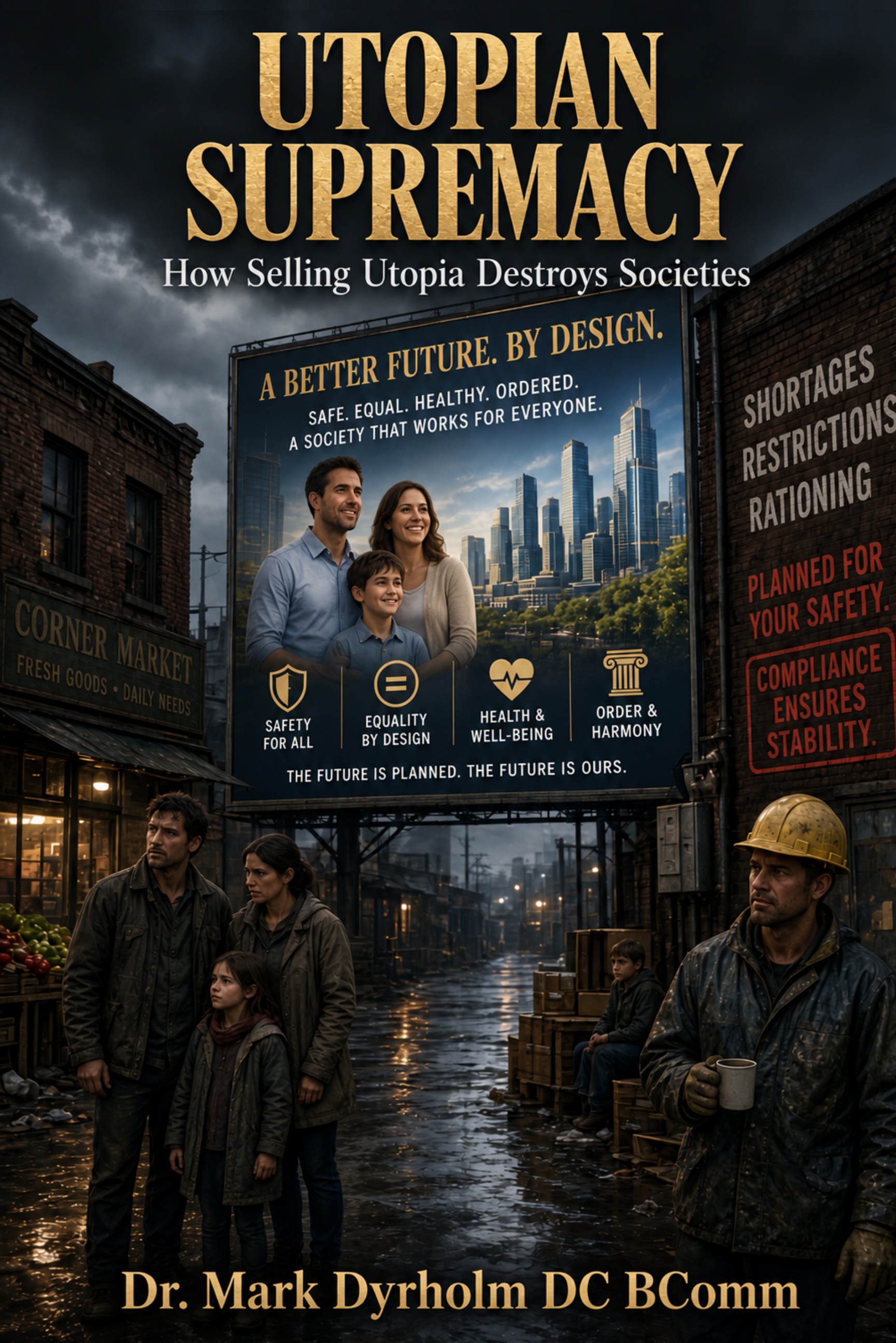
Utopian Supremacy
How Selling Utopia Destroys Societies
By Dr. Mark Dyrholm DC BComm
Hope needs room for correction. Read it for yourself, share it with a thoughtful friend, or choose it for your next book club.
Now available on Amazon.
Buy on Amazon Canada Buy on Amazon USCheck Amazon for current availability, formats, prices, and delivery. Paperback ISBN: 978-1-0696662-0-8.
Media & speaking
Media may request a reading copy. For interviews, speaking enquiries, or questions, contact Dr. Mark Dyrholm DC.